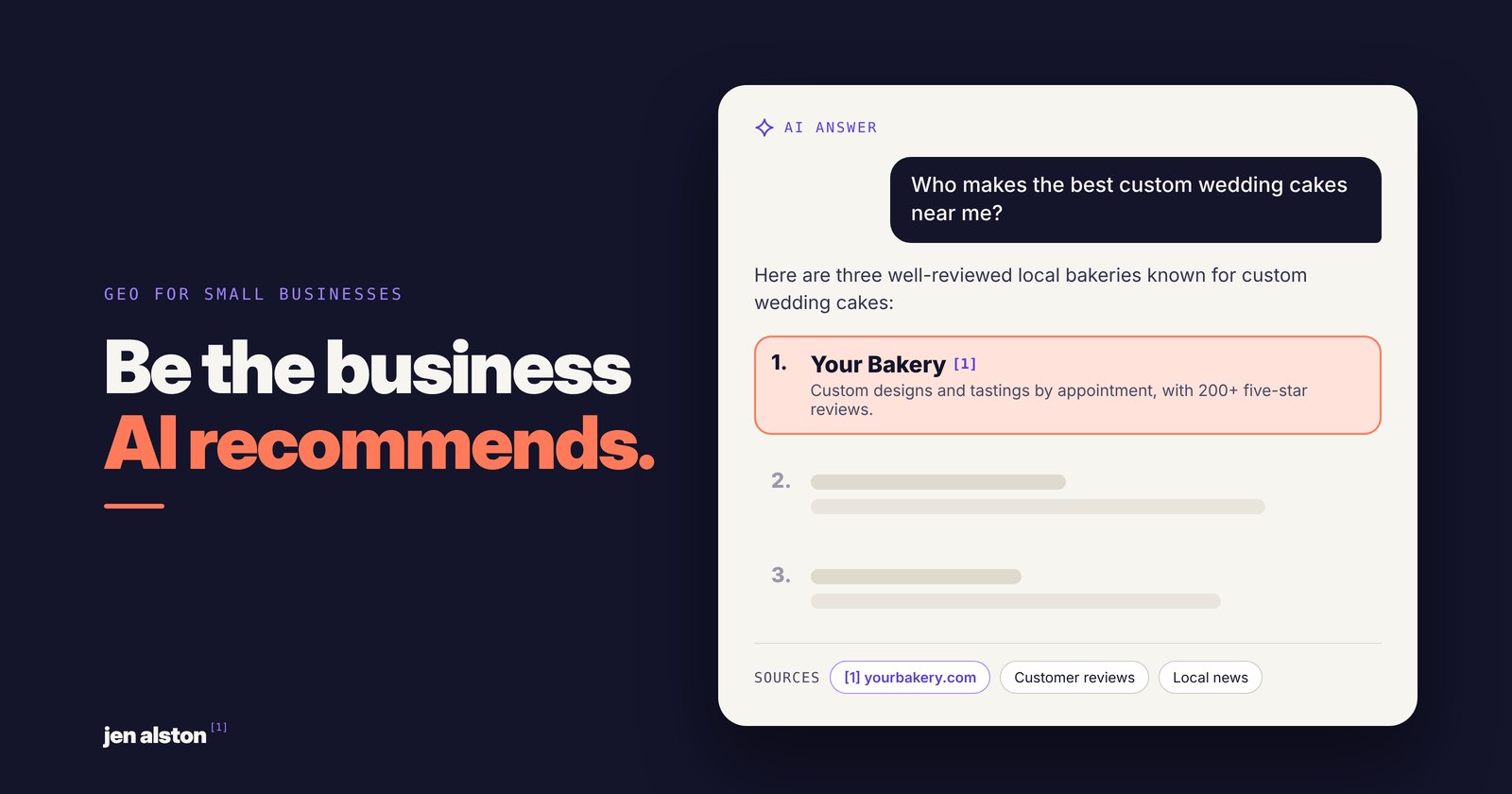
A growing number of your customers no longer type “plumber near me” and scroll through ten blue links. They ask ChatGPT which plumber to call, ask Google’s AI Overview which bakery makes the best custom cakes, or ask Gemini to compare three local accountants.
The businesses named in those answers get the call. The rest don’t get a chance.
Getting named is what GEO, or generative engine optimization, is about. If you’re a small business owner who has heard the term and wondered whether it applies to you, this guide is for you.
Key takeaways
- GEO makes your business easy for AI tools to recommend. That includes ChatGPT, Gemini, Perplexity and Google’s AI Overviews.
- GEO builds on SEO. The goal shifts from ranking in a list of links to being mentioned, cited or recommended inside the answer.
- AI tools favor businesses that are easy to identify, clearly described, talked about by others and useful to quote.
- Start with a baseline: ask five customer questions in four AI tools, then fix your listings, answer real questions on your site and earn mentions.
- No one can guarantee an AI recommendation, but you can raise your odds and measure your progress every month.
What GEO means, in plain English
Quick answer
What is GEO (generative engine optimization)?
GEO, or generative engine optimization, is the practice of making a business easy for AI tools to find, understand and recommend. It helps your business appear in answers from tools like ChatGPT, Gemini, Perplexity and Google's AI Overviews.
GEO is the practice of making your business easy for AI tools to find, understand and recommend. Those tools include ChatGPT, Google’s AI Overviews and AI Mode, Gemini, Perplexity and Microsoft Copilot.
You’ll also hear AEO (answer engine optimization). The two overlap heavily. Both focus on earning a place in the answers people get, not just a spot in a list of links.
Is GEO different from SEO?
Quick answer
What's the difference between GEO and SEO?
SEO aims to rank your pages high in search results. GEO aims to get your business mentioned, cited or recommended inside AI-generated answers. GEO builds on SEO, because AI tools often draw on the websites that already rank well.
GEO builds on SEO rather than replacing it. AI tools often pull from search results and the websites that rank well, so the basics of SEO still matter: a fast, clear website, helpful content and a solid Google Business Profile.
What changes is the goal. SEO aims for a high ranking. GEO aims for a mention, a citation or a recommendation inside the answer itself, and AI tools gather evidence from more places than your website alone: reviews, directories, local news, forums and articles that compare businesses like yours.
How AI tools decide who to recommend
Quick answer
How do AI tools decide which businesses to recommend?
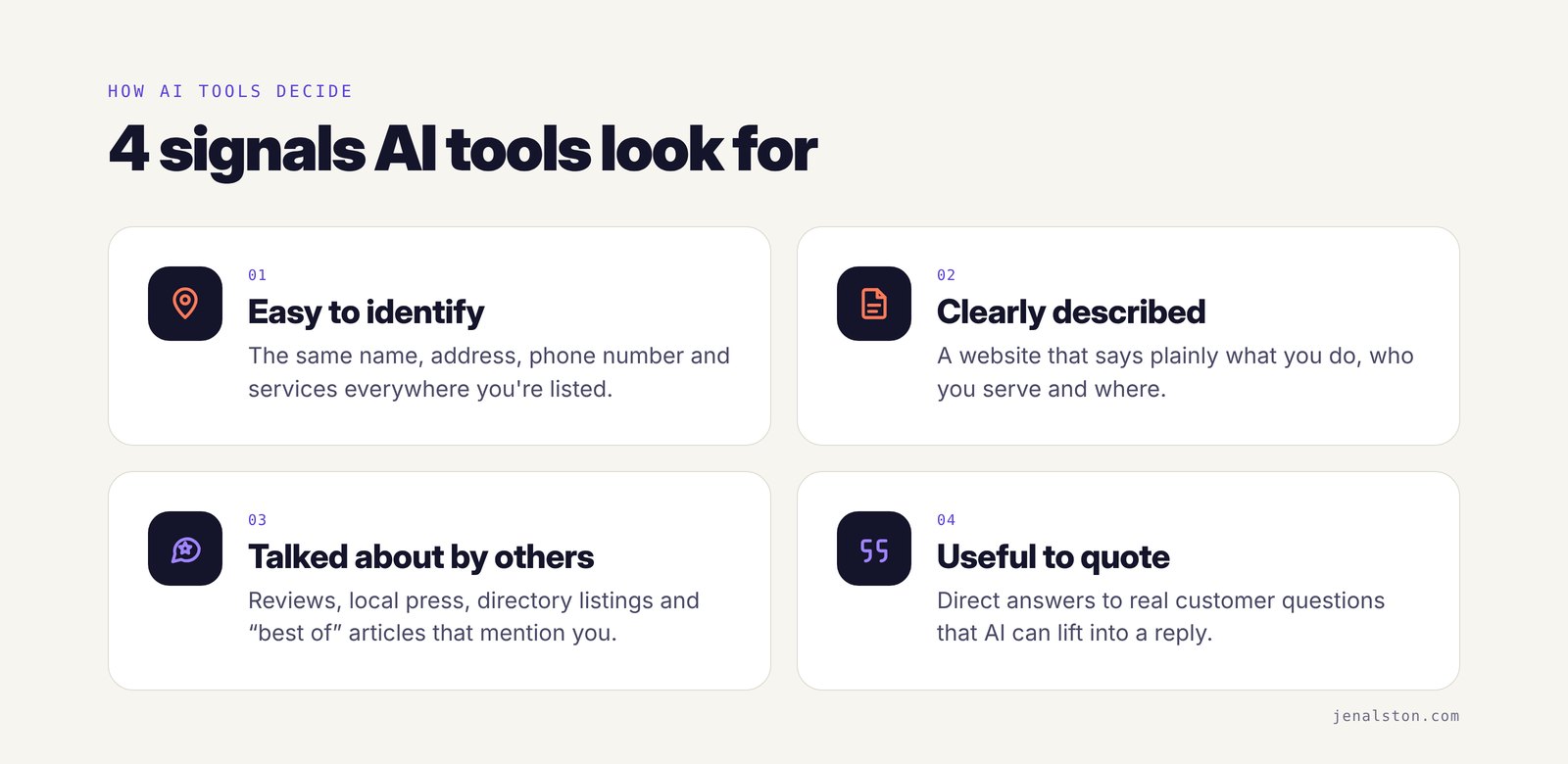
AI tools tend to recommend businesses that are easy to identify, clearly described, talked about by others and useful to quote. They look for consistent business details, clear websites, reviews and mentions elsewhere, and direct answers to customer questions.
No one outside these companies knows every detail, but the patterns are consistent. AI tools favor businesses that are:
- Easy to identify. Your name, address, phone number and services match everywhere they appear online.
- Clearly described. Your website states plainly what you do, who you serve and where.
- Talked about by others. Reviews, local press, directory listings and “best of” articles mention you.
- Useful to quote. Your pages answer real questions directly, in language an AI can lift into an answer.
7 steps to get started
Quick answer
How can a small business show up in ChatGPT and other AI answers?
Start by checking where you appear today, then make your business details consistent everywhere, answer real customer questions on your website, add structured data, and earn reviews and mentions on trusted sites. Pair your business name with your services and location, and make sure AI crawlers can read your site.
1. See where you stand today
Quick answer
How do I check if AI tools mention my business?
Ask ChatGPT, Gemini, Perplexity and Google five questions your customers would ask, and note whether your business is mentioned, which competitors appear and which websites are cited as sources. Record the results as a baseline, then repeat the same questions monthly.
Open ChatGPT, Gemini, Perplexity and Google, and ask five questions a customer would ask, like “Who’s the best dog groomer in Austin?” or “What’s a good bookkeeper for a small restaurant?” Note whether you’re mentioned, which competitors are, and which websites the AI cites as sources. Write it down. That’s your baseline. (For a more thorough method, see my guide to measuring AI share of voice.)
2. Make your business details consistent everywhere
Check your Google Business Profile, Bing Places, Apple Business Connect, Yelp, Facebook and any directories for your industry. Your business name, address, phone number, hours and website should match exactly across all of them. Conflicting details make AI tools less confident about who you are.
3. Answer real customer questions on your website
Add a frequently asked questions section, and give each service its own page. Start each answer with a direct, one- or two-sentence reply, then add detail. Include the specifics people actually want: the areas you serve, typical price ranges, how long a job takes and what the process looks like. Specific, quotable answers are exactly what AI tools look for.
4. Add structured data to your site
Structured data, or schema markup, is behind-the-scenes code that labels your business information for machines: your business type, address, hours, services and reviews. If your site runs on WordPress, plugins such as Yoast or Rank Math can add the basics for you. Most other website builders have a setting for it too.
5. Earn mentions in the places AI looks
Ask happy customers for reviews, and reply to them. Get listed in reputable directories for your industry and city. Pitch local news outlets and bloggers who publish “best of” roundups in your area. Take part genuinely in community forums where your customers ask for recommendations. Every trustworthy mention is another piece of evidence that you’re a real, recommended business.
6. Put your name next to what you do
AI tools learn by noticing which words appear together. “Sunrise Bakery makes custom wedding cakes in Denver” teaches the connection far better than a page that only says “We make cakes.” Pair your business name with your services and location on your own site and anywhere you’re listed.
7. Make sure AI tools can read your site
Some website setups block AI crawlers without the owner realizing it. Ask your web developer, or check your site’s robots.txt file, to confirm you’re not blocking AI search crawlers such as OAI-SearchBot (ChatGPT search) and PerplexityBot, unless you’ve made that choice on purpose.
What GEO can’t do
GEO can’t guarantee that a specific AI tool will recommend you for a specific question. Answers vary between tools, between users and from one day to the next. Be wary of anyone who promises a guaranteed top spot in ChatGPT.
What GEO can do is raise the odds that you’re mentioned and let you measure whether your visibility is improving over time.
Your quick-start checklist
- Ask five customer questions in four AI tools and record the results
- Match your name, address, phone and hours across every listing
- Add an FAQ section with direct answers
- Give each service its own page with real specifics
- Add LocalBusiness schema to your website
- Ask three happy customers for reviews this month
- Find two industry or local directories to join
- Check that your site isn’t blocking AI search crawlers
- Repeat your five questions in 30 days and compare
Frequently asked questions
How long does GEO take to work?
Some changes, like fixing listings or adding FAQ content, can show up in AI answers within weeks. Building a reputation through reviews and mentions takes months. Measure monthly so you can see the trend.
Do I need a new website?
Usually not. Most small business websites can be improved with clearer service pages, an FAQ section and structured data, without a full rebuild.
Can I do GEO myself?
Yes. Every step in this guide is something a business owner can start on their own. Where an expert helps is in testing systematically, finding the sources AI tools trust in your industry, and turning the results into a plan.
Does GEO replace SEO or Google Ads?
No. Think of it as an extension of SEO. Strong search basics make GEO easier, and paid ads still have their place for immediate visibility.
Summary
GEO helps your business get named when customers ask AI tools for recommendations. It builds on the SEO basics you may already have, then focuses on the signals AI tools rely on: consistent business details, a clear website that answers real questions, and reviews and mentions on trusted sites. Start by testing five customer questions to see where you stand, work through the seven steps and the checklist, and measure again each month. No one can guarantee a recommendation, but steady work raises your odds.
If you’d like to know exactly how AI tools see your business today, and what to fix first, let’s talk. An AI visibility audit shows where you’re mentioned, where your competitors are winning, and the steps most likely to change that.